 Cruise to St Lucia
The Gros Piton Hike
Gros Piton is the taller, saner, only-officially-climbable half of Saint Lucia's twin peaks: 771 metres (2,619 ft) of jungle stairway rising straight off the sea, with a summit that pays in views over both coasts at once. The Gros Piton hike is government-run, guide-mandatory and honest about its demands - near two hours of relentless climbing up, and knees that remember the way down. This guide covers the numbers, the fee, the start-time strategy, and the arithmetic of fitting a volcano-shaped mountain into an eight-hour port call. Every stop named here is priced in the St Lucia shore excursions compared on this site.
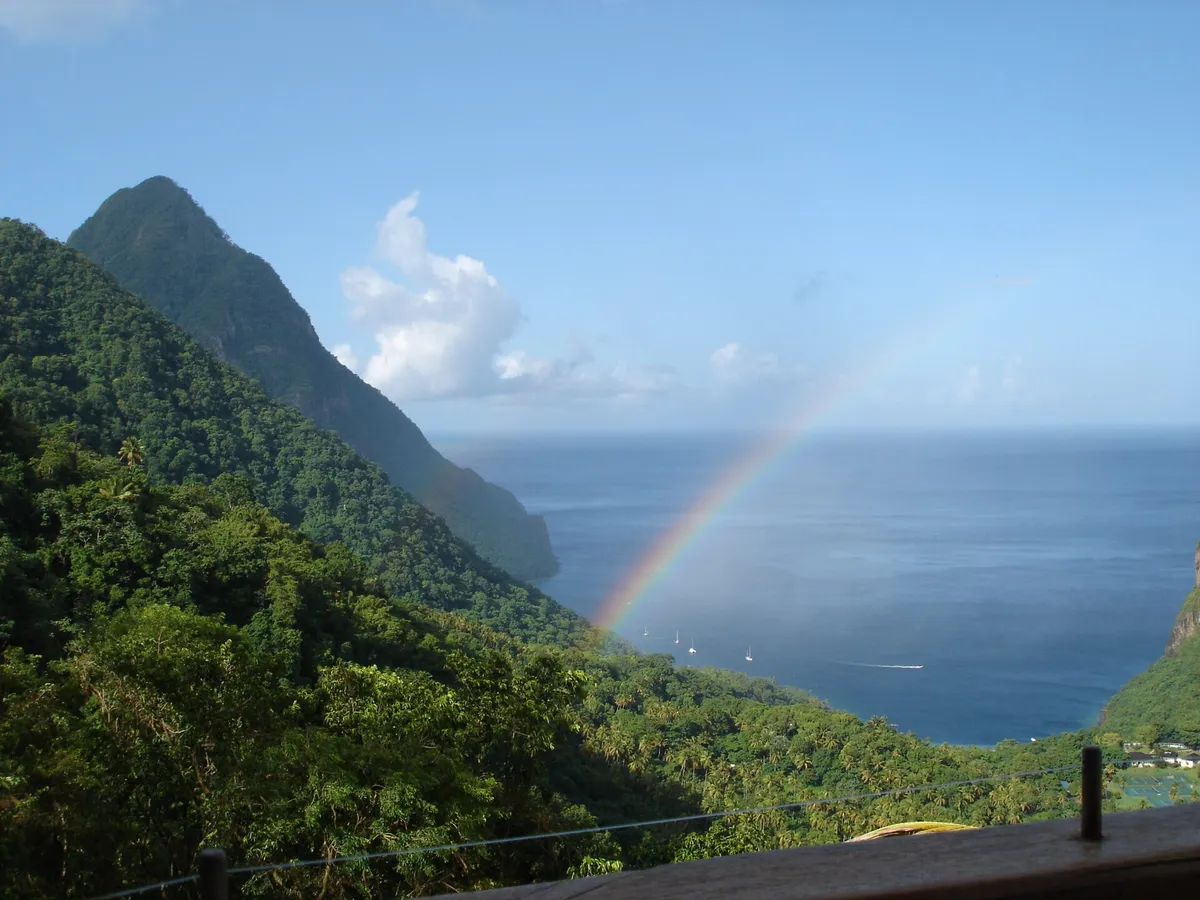
Gros Piton, 771 m of volcanic plug straight off the sea - the summit route climbs its forested flank. Photo: Jayen466, Wikimedia Commons, Public domain.
Quick answer Four hours round trip, a US$50 fee that includes the mandatory guide, and a start-time rule that decides everything
The Gros Piton hike is a 2.9-mile (4.7 km) out-and-back that climbs the entire way: roughly two hours up for an average hiker, a little less down, four hours on the mountain all-in. It is steep, rocky and root-laced the whole route - no scrambling skill needed, real fitness required. Entry is US$50 per person, and that fee includes the mandatory certified trail guide assigned at the gate; hiking without a guide is not permitted. Start between 7 and 8 am to beat both the heat and the 10-11 am cruise-group rush. On a port day the arithmetic is tight: the trailhead sits near Soufriere, about 90 minutes from the ship, so only tours with early fixed transfers - like the Gros Piton listing in our comparison - fit the standard eight-hour call, and only for hikers who hold a honest 4-hour pace.
Key takeaways
- Comparing the port-day listings? The homepage comparison shows which tours bundle the park fee and which add it at the gate
- Not fit for four hours uphill? The viewpoints that need no climb deliver the same postcard from sea level
- Petit Piton is a different animal: see why it is not a hike before anyone talks you up it
The Route, Stage by Stage
The trail starts from the Gros Piton trailhead gate at Fond Gens Libre, a village lane above the coast road south of Soufriere, where every hiker signs in, pays and collects a guide. The route is one path, there and back - no loops, no shortcuts - and it divides naturally into thirds.
The first third is the warm-up that is not one: steady stone steps through gardens and light forest, gradient already serious, the sea dropping away behind you. The middle third is the jungle proper - roots, slick rock after rain, and the gradient steepening into staircases of eroded stone where hands join the work on the downs. Trees part for two named rest viewpoints along the way, each worth its pause. The final third climbs the open shoulder - boulder steps, wind, and the summit ridge arriving almost abruptly at a flat, grassy top with the island spread out both ways.
Summit time: Soufriere town and its volcano below to one side, the full length of Petit Piton to the other, the south coast running to Vieux Fort and, on clear days, the faint line of neighbouring islands. Guides run a firm pace-and-rest rhythm, carry first aid, and will turn a hiker around without drama at the halfway decision point - a rule that has kept this trail's record clean.
How Hard Is It, Honestly
The internet's answer splits into 'easy' and 'brutal', and both are wrong for the same reason: fitness is relative, the mountain is not. The measurable version: 2.9 miles round trip, 771 metres of elevation gained, near-two-hour continuous climb - the gradient, not the distance, is the event. Anyone who climbs flights of stairs without conversation for an hour will finish it tired and triumphant; anyone whose weekly stair total is small will meet their limit in the middle third, where most turnaround decisions happen.
What it is not: technical. No ropes, no scrambling beyond hand-on-rock steps, no exposure over drops - the trail is a steep staircase wearing a jungle. What it genuinely demands: working knees for the descent (poles help; rentals exist at the gate for a few dollars), more water than seems reasonable - a litre per person minimum, none available on the mountain - and the honesty to train, not hope, before a cruise week.
Weather shifts the grade. Dry-season mornings give grip and breeze; wet-season rock runs slick, the midday sun gaps are punishing, and after heavy rain the guides slow the pace rather than the route. Age cuts both ways here: the trail is regularly summited by fit seventy-year-olds and abandoned by thirty-year-olds who skipped leg day - the mountain grades effort, not age.
The Gros Piton Hike by Numbers
The figures that decide the day, read from the trail's operators, the park fee schedule and published route data.
| Figure | Number | What it means for the day |
|---|---|---|
| Summit height | 771 m / 2,619 ft | The taller Piton; the lower one is the unclimbable-looking Petit |
| Route length | 2.9 mi / 4.7 km out-and-back | One trail, no loops - down is the same stone as up |
| Elevation gain | 771 m in ~2.3 km of trail | Relentless stair-steep gradient; the challenge is grade, not mileage |
| Typical round trip | About 4 hours | Near 2 h up for average hikers, 1.5-2 h down; the trail closes to late starts |
| Entrance fee | US$50 per person | Includes the mandatory certified guide; tips customary; cards usually accepted at the gate |
| Guide rule | Mandatory, assigned at the gate | No independent hiking; guides carry first aid and set turnaround calls |
| Best start | 07:00-08:00 | Beats the 10-11 am cruise-group wave and the midday heat |
| From the cruise port | About 90 min each way by road | Only early-transfer tours fit a standard 8-hour call |
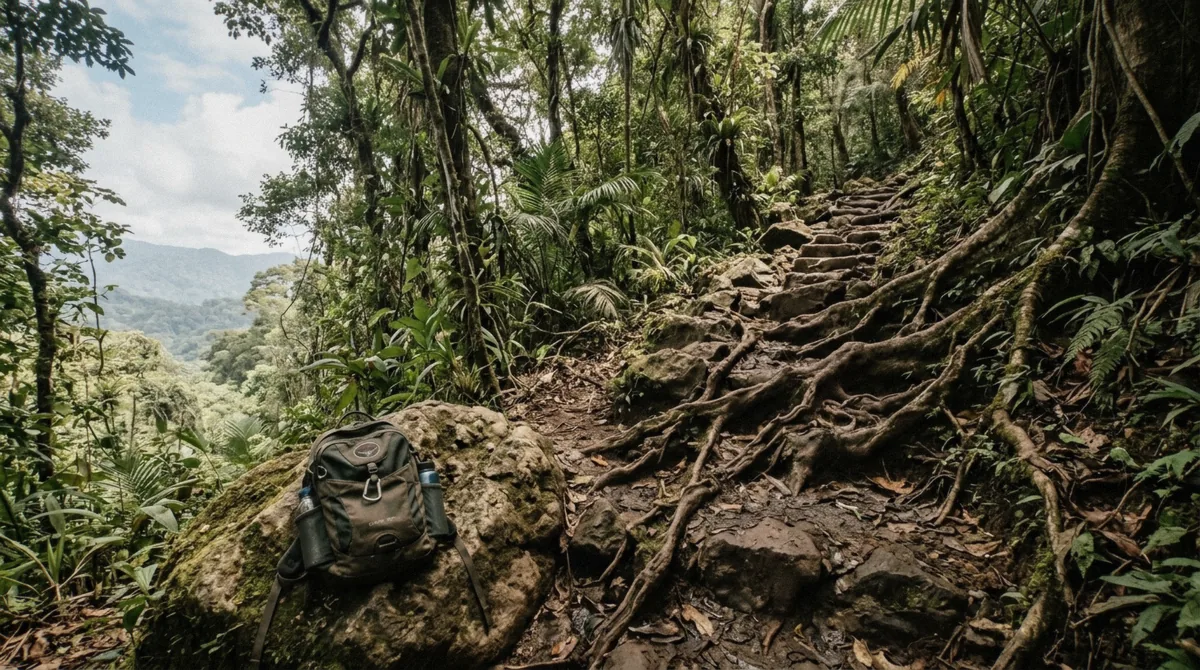
The middle third: root and stone staircases where hands join the work. A litre of water per person is the honest minimum. Editorial illustration generated for this guide.
The US$50 Fee, the Mandatory Guide, and What Tours Add
The Gros Piton trail is managed by the island's forestry authorities, and its gate system is firm: every hiker pays US$50 and walks with an assigned certified guide. The fee is the park's, not a tour company's - driving yourself to the gate and paying on the spot is exactly the same US$50. The guide assignment is included in it; tips are the customary thank-you at the summit, and cards are usually accepted, though cash keeps the gate queue short.
What the tour listings add is everything around the mountain: early fixed transfers from the cruise terminals (the decisive item on a port day), breakfast or a post-hike meal, the gate-fee handling - some listings include the US$50 in the price, others collect it at the trailhead, and the difference is always stated in the listing's inclusion line - and the guide reservation itself, which spares you the gate queue on busy cruise mornings.
The distinction matters when comparing prices: an US$85 listing that includes the park fee is cheaper than a US$60 one that does not, and the comparison table on the homepage splits the column exactly so the arithmetic stays visible.
The Port-Day Arithmetic
Here is the day that has to fit: ships typically berth 07:00-08:00 and sail 17:00-18:00; the trailhead sits about 90 minutes from the piers; the mountain wants four hours; all-aboard discipline wants you back with an hour spare. Add the numbers and the answer is unforgiving - a Gros Piton port day only works early, fixed and fast.
The tour listings solve the first and third parts: pickup at the pier by 08:15, gate by 09:45, summit by noon, down by 14:00, ship by 16:00 with the buffer intact. What no listing can solve is the middle part - the hike itself takes the time it takes. Guides on port-day runs hold groups to a working pace, and the turnaround rule applies to the ship's schedule as much as to stamina: halfway is the decision point either way.
So the honest shortlist for booking: a long port call (10 hours or more) makes the climb comfortable; a standard 8-hour call makes it a workout with a deadline, suited to the already-fit; and anything shorter is a no - the west-coast boat tours put the Piton in the camera rather than under the boots, and fit the same hours with lunch and a swim attached.
Petit Piton: Why It Is Not a Hike
The pointed peak in every Saint Lucia photograph - Petit Piton, 743 metres, rising like a wall straight from the sea between Soufriere and Sugar Beach - is visible from every tour boat and climbed by a handful of people a year, for good reason. There is no maintained trail: the route is a steep, eroded scramble up rope-and-root lines through dry forest, with real exposure, route-finding through growth, and sections graded by those who do it as beyond anything the Gros side asks. Climbing experience is the standard prerequisite, guides who know the line are essential, and the park system does not run it as a public trail the way Gros is run.
For port-day purposes the advice is simple: see Petit from the water, where every catamaran and speedboat tour passes its base, or from the classic photo angles around Soufriere Bay. The mountain is not going anywhere, and neither is its reputation - the honest workout with the summit view belongs to its bigger neighbour across the bay.
Gros Piton Without the Climb: Where the Views Are Free
The summit is earned, but the postcard is not gated. The classic angles: Sugar Beach, wedged directly between both peaks, where the pair frame the sand in the photograph everyone came for; the deck of any west-coast tour boat, which rounds the Pitons close enough to read the rock strata; the Soufriere waterfront and jetty, where both peaks stack over the town's roofs; and the viewpoints above Soufriere on the road from Castries, where a driver stops at the named pull-ins.
On the land side, the Morne Coubaril estate and the ridge road toward Fond St Jacques look up at Gros Piton's flank from plantation country, and the aerial tram's mountain sits far enough north that the pair line up across the water on clear days. Every one of these fits inside a standard port call with lunch attached - which is the trade most visitors happily make: the mountain in five photographs and a mud bath, rather than the mountain in the legs.
The Descent: The Half Nobody Trains For
The Gros Piton descent is the trail's honest punchline: the same stone steps that punished the lungs on the way up punish the quadriceps on the way down, and the review record's soreness complaints cluster on the second half of the out-and-back, not the first. The biomechanics are simple - braking downhill loads the front of the legs with every step, on stone that the morning's rain or the day's dust has made conspiratorial - and the hours accumulated by the summit mean the descent starts on already-spent legs.
The technique the guides coach: short steps, weight back, hands free for the roots - walking poles earn their rental fee twice over on the way down, and the 'knees over toes' habit is the difference between a sore night and a lost sea day. Shoe choice matters more downhill: the trail's dust-slick stone wants grip, not fashion, and the halfway rest stop on the way up becomes the knees' negotiation point on the way back.
The timing reality for a port day: the descent runs nearly as long as the climb - near two hours down against two up - which is why the honest round trip is four hours and why this page's port-window math never shrinks it. The summit photograph is the memory; the descent is the price, and the beer for the ride home is the receipt.
Training for a Volcano in Six Weeks
The difference between the five-star reviews and the 4.2 average on this climb is mostly leg-day decisions made weeks before the cruise - so here is the honest preparation, sized for a traveller with a life and a gym membership they barely use.
The base (weeks 1-2): stairs and walking. The trail is a staircase wearing a jungle; train the actual motion. Twenty minutes of real stairs - the office fire stairwell, the stadium steps - three times a week, plus one long walk (60-90 minutes) on the weekend. If the stairs finish you in ten minutes, the mountain will finish you at the halfway decision point.
The build (weeks 3-4): load and decline. Add a pack - a daypack with 5 kg teaches the shoulders what the water will ask - and find descents: downhill treadmill, hill repeats, the stadium the other direction. The eccentric (downhill) work is what prevents the soreness that ruins the cruise's next two days.
The peak (weeks 5-6): the rehearsal. One two-hour continuous climb - a long hill, a mountain, the stairmaster's longest setting - at conversation-pacing, and then one full rest week before sailing. The test that predicts the summit: can you climb sixty continuous minutes and hold a sentence? Then Gros Piton is a long morning. If not, six more weekends - the mountain does not negotiate, but it does wait.
The Climb with Kids and Teens
Gros Piton has no minimum age, and the trailhead's waiver desk has seen everything from seven-year-olds in school shoes to grandparents out-climbing their grandchildren - the mountain grades the legs, not the birth certificate. The honest family calculus still has structure.
The reliable sweet spot is roughly ten and up, with the climb already in their legs - a fit ten-year-old who hikes at home finishes this trail grinning; a screen-athlete twelve-year-old discovers the halfway turnaround rule from the inside. Teenagers are the format's natural audience: the summit's both-coasts view lands hardest on people old enough to understand what they are looking at, and the four-hour structure fits teenage pacing better than any tour clock.
The younger-child rules, from the guides' own practice: one adult per child within arm's reach for the middle third; the turnaround call made at the halfway mark by the adult, not the child - seven-year-olds have no altitude-pacing instrument and no off-switch; and the descent is where young legs fail first, so the carrier-question (can you carry a 20 kg child down 771 m of stone?) gets answered honestly before the gate, not on it.
And the split-plan alternative: the family that splits - hikers to the mountain, everyone else to Reduit's calm water - loses nothing but the shared suffering, and the reunion lunch is the port day's best table. The mountain has waited three million years; it can wait for the second visit.
Gros Piton Hike: Questions Before the Gate
How long does it take to hike the Gros Piton?
About four hours round trip for an average hiker: near two hours up the continuous climb, an hour and a half to two hours down, plus gate formalities. Fit hikers cut an hour off that; anyone stopping at every viewpoint should budget five.
How hard is the Gros Piton hike?
Hard in gradient, not in technique: 771 metres of elevation over a 2.9-mile route, mostly stair-steep rock and root through rainforest. No scrambling skill or exposure - real aerobic fitness and working knees are the price. The descent is harder on the knees than the climb is on the lungs.
Can you hike Gros Piton without a guide?
No. The trail is guide-mandatory: every hiker is assigned a certified guide at the gate, included in the US$50 entrance fee. The rule is enforced, and guides carry first aid and set turnaround calls at the halfway point.
What does the Gros Piton hike cost?
The park gate fee is US$50 per person, guide included; tips are customary and pole rentals run a few dollars. Tours from the cruise port add transfers and often the fee itself - listings state plainly whether the US$50 is inside their price or collected at the trailhead.
How difficult is the Petit Piton hike?
Beyond the Gros scale entirely: no maintained trail, rope-and-root scrambling with real exposure, route-finding through growth, and a standard prerequisite of genuine climbing experience. It is not run as a public trail; most visitors meet Petit Piton from the water or from the Soufriere viewpoints.
Can you hike Gros Piton on a cruise port day?
Only with an early, fixed-transfer tour and a long port call: the trailhead sits about 90 minutes from the ship, the mountain wants four hours, and the all-aboard buffer takes the rest. On a standard 8-hour call it is a fit-hiker-only day; on shorter calls the boat tours put the Pitons in frame instead of underfoot.
What do I eat before and after the climb?
Before: a real breakfast at the ship - the trail burns through light breakfasts by the second third, and there is no food on the mountain. Pack the snacks: nuts, bars, the banana from the buffet. After: the ride-home beer is included, but rehydration wants water first - and the Creole lunch in Soufriere on the drive back is the island's best-earned plate.